










The Ashwagandha vs Rhodiola comparison comes up frequently when people are looking for adaptogens to help them navigate periods of stress, mental fatigue or high physical and cognitive demand. Although both plants are commonly grouped under the adaptogen category, they are not interchangeable and have not been studied for exactly the same purposes.
Ashwagandha has a relatively broad body of research focused on perceived stress, sleep and the physiological response to stress. Rhodiola rosea, on the other hand, has traditionally been associated with fatigue, feelings of weakness and mental performance during demanding situations.
So the most useful question is not simply which one is better, but what type of stress or fatigue is most relevant and what evidence supports each extract.
Ashwagandha vs Rhodiola: key differences between these adaptogens
A systematic review published in 2026 examined clinical trials involving both plants. It included 19 studies on Withania somnifera and 5 on Rhodiola rosea, covering outcomes related to stress, sleep, fatigue, cognition and other parameters.
However, having research on both plants does not mean that one has been directly proven superior to the other. Most of the available evidence comes from separate trials using different extracts, doses, populations and intervention periods.
Has a relatively broad clinical literature on perceived stress and sleep. The extracts used and their withanolide concentrations can vary considerably.
Has been investigated particularly in situations involving physical or mental fatigue, stress and feelings of weakness.
There is not enough direct comparative evidence to say that one plant is better than the other for every person or situation.
The plant name alone is not enough. Plant part, standardisation, dose and raw material all affect how the evidence should be interpreted.
Ashwagandha: when it may make more sense
Ashwagandha (Withania somnifera) is a traditional Ayurvedic plant that has been widely investigated in relation to stress.
A systematic review and meta-analysis published in 2024 evaluated nine randomised trials involving 558 participants and reported favourable findings across several stress- and anxiety-related measures, although the studies used different preparations and doses.
The US National Center for Complementary and Integrative Health notes that certain ashwagandha preparations may be helpful for stress and insomnia, while also pointing out that many studies are relatively small and use different formulations.
For this reason, ashwagandha may be particularly relevant when the main issue is ongoing stress, difficulty switching off or disrupted rest during demanding periods.
That does not mean it is suitable for everyone. Ashwagandha may cause drowsiness or gastrointestinal discomfort, and specific precautions apply during pregnancy and breastfeeding, as well as for people with certain thyroid or autoimmune conditions or those taking particular medications.
Rhodiola for mental fatigue: where its profile differs
Rhodiola rosea is also considered an adaptogenic plant, but a significant part of its research has focused on mental and physical fatigue associated with stress.
A systematic review on fatigue reported positive findings in some trials, but also highlighted methodological limitations and a substantial risk of bias across parts of the literature. The evidence should therefore be interpreted cautiously.
The European Medicines Agency also recognises the traditional medicinal use of Rhodiola rosea preparations for the temporary relief of stress-related symptoms such as fatigue and feelings of weakness.
It is important to note that this EMA conclusion relates to traditional herbal medicinal products and does not automatically represent an authorised health claim for every dietary supplement containing rhodiola.
When the dominant issue is mental exhaustion, reduced concentration or a sense of fatigue during a particularly demanding period, rhodiola therefore has a somewhat different research profile from ashwagandha.
Ashwagandha or Rhodiola: how to choose according to your goal
Rather than looking for an absolute winner between ashwagandha or rhodiola, it is more useful to consider the context.
Ashwagandha currently has a broader clinical evidence base relating to perceived stress and several parameters associated with the stress response.
Ashwagandha has also been studied in relation to sleep, making it particularly relevant when stress and poor rest are closely connected.
Rhodiola has a particularly interesting research profile when tiredness, weakness or reduced mental performance dominate during demanding periods.
Both plants have been investigated as adaptogens, but outcomes depend on the extract, dose, duration and individual characteristics.
There is not enough evidence to establish that combining ashwagandha and rhodiola is necessarily better than selecting one well-chosen approach according to the goal. It is also inappropriate to assume that two supplements containing these plants will be equivalent when their extracts and concentrations differ.
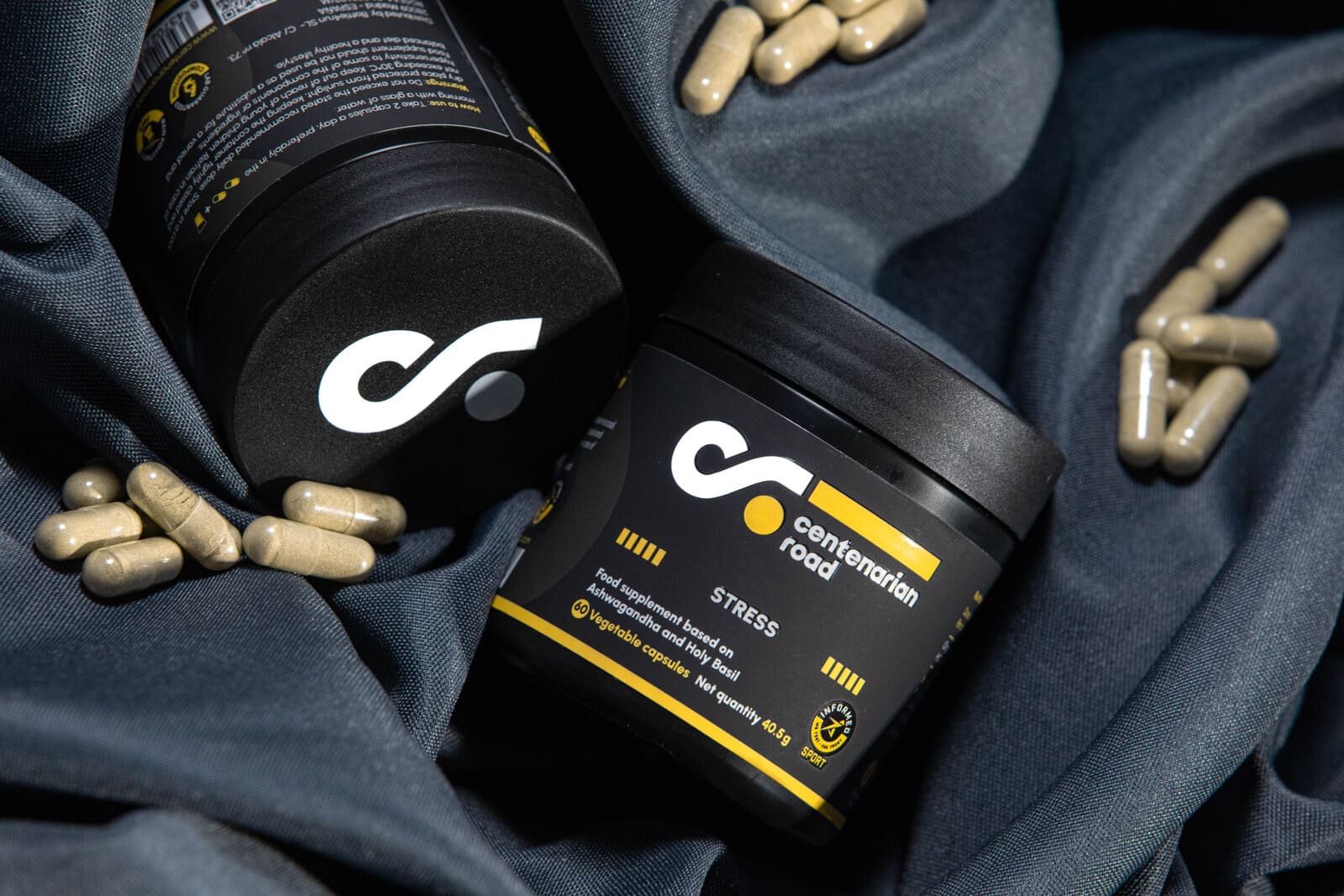
Stress by Centenarian Road: Ashwagandha KSM-66® and Holy Basil for demanding periods
Stress by Centenarian Road follows an ashwagandha-based approach. Its formula combines 600 mg per day of Ashwagandha KSM-66® root extract with 250 mg of Holy Basil Holixer® in the recommended daily serving of two capsules.
KSM-66® is a standardised ashwagandha root extract, while Holixer® provides an extract of Ocimum tenuiflorum, also known as Holy Basil. Therefore, Stress does not contain Rhodiola rosea and should not be presented as a combination of the two adaptogens.
600 mg per day of ashwagandha root extract based on Centenarian Road's recommended serving of two capsules.
250 mg per day of Holy Basil extract to complement the adaptogenic formula in Stress.
The formula is Informed Sport certified, which is particularly relevant for athletes who may be subject to anti-doping testing.
It may make sense for people looking for an ashwagandha-based formula as part of a broader strategy during periods of high physical or mental demand.
View Stress by Centenarian Road
Frequently Asked Questions About Ashwagandha vs Rhodiola
Which is better for stress, Ashwagandha or Rhodiola?
There is no universal answer. Ashwagandha currently has a broader body of clinical research focused specifically on stress, while rhodiola is particularly relevant in situations where stress is accompanied by fatigue or feelings of weakness. The choice should also take into account the specific extract, dose and individual context.
Which is better for mental fatigue, Ashwagandha or Rhodiola?
Rhodiola has a traditional use and research profile particularly associated with physical and mental fatigue linked to stress. This does not mean that direct clinical comparisons have proven it superior to ashwagandha, but its research profile makes it especially relevant when mental exhaustion is the main concern.
Can Ashwagandha and Rhodiola be taken together?
Some supplements and routines combine adaptogens, but adding more ingredients does not automatically produce better results. Before combining concentrated botanical extracts, it is worth considering dose, tolerance, medication and individual circumstances, particularly when diagnosed conditions or prescription treatments are involved.
Can Ashwagandha be taken every day?
Clinical studies generally evaluate limited supplementation periods, and the manufacturer's directions should always be followed. The NCCIH notes that most available safety information relates to short-term use and that there is not enough evidence to draw firm conclusions about long-term safety. In certain situations or when taking some medications, professional advice may be appropriate before supplementation.
Scientific References
Clinical evidence for the adaptogenic effects of Withania somnifera and Rhodiola rosea — Łuszczak J., Kocki J., 2026
A systematic review of clinical trials involving ashwagandha and rhodiola. It included 24 studies — 19 on Withania somnifera and 5 on Rhodiola rosea — and reported findings relating to stress resilience, sleep, cognition and fatigue while also highlighting important methodological limitations.
Original URL: https://pubmed.ncbi.nlm.nih.gov/41906501/
Effects of Ashwagandha (Withania Somnifera) on stress and anxiety: A systematic review and meta-analysis — 2024
A systematic review and meta-analysis of nine randomised trials involving 558 participants and different ashwagandha preparations, assessing outcomes related to stress and anxiety.
Original URL: https://pubmed.ncbi.nlm.nih.gov/39348746/
Rhodiola rosea for physical and mental fatigue: a systematic review — Ishaque S. et al., 2012
A systematic review of Rhodiola rosea for physical and mental fatigue. Some trials reported favourable outcomes, although the review also highlighted methodological weaknesses and risk of bias in the available literature.
Original URL: https://pubmed.ncbi.nlm.nih.gov/22643043/
Rhodiolae roseae rhizoma et radix — European Medicines Agency
European herbal monograph on Rhodiola rosea. The HMPC recognises its traditional medicinal use for the temporary relief of stress-related symptoms such as fatigue and feelings of weakness, while noting that the conclusion is based primarily on traditional use and that the available clinical evidence has limitations.
Original URL: https://www.ema.europa.eu/en/medicines/herbal/rhodiolae-roseae-rhizoma-et-radix
Ashwagandha: Usefulness and Safety — National Center for Complementary and Integrative Health, NIH
An official evidence and safety overview of ashwagandha. It notes potentially useful findings for stress and insomnia while also highlighting limitations in the evidence and precautions relating to pregnancy, thyroid or autoimmune conditions and certain medication interactions.
Original URL: https://www.nccih.nih.gov/health/ashwagandha